

»We must be crazy. Tourists, travellers, adventurers, overlanders… however you name yourself and what you supposedly do, you’re still crazy.« I kept thinking these thoughts as I hit my head on the low rocky ceiling of Karaftu Caves once again. And again too soon after that. With a DSLR in one hand and GoPro camera in the other and with a quite stiff back from driving for a whole week incessantly the crawling through the narrow tunnels of Karaftu Caves wasn’t very pleasant. »Some weirdos about 2.500 years ago decid ed to live in the cave, and now, more than two millennia later, we drive 5.000 kilometres to crawl into that same cave and pretend that we can imagine how it looked like so long time ago. We’re absolutely crazy.«
Personally, I’m not much of a fan of man-made historical sights. In general I don’t like churches because most often they occupy and usurp the best ancient sacred energetic places in their vanity and self-righteousness, I don’t like museums, castles, old ruins… in general, I said. I prefer to call them old rocks. But still on almost every trip we do spare some time for these old rocks. And if I add that the trouble with overlanding in Iran is the sheer distance between points of interest… from one place you want to see to the next you can easily drive for even more than 600 kilometres. If it’s less than 300, you can consider yourself lucky. This fact contributed to adding of Karaftu Caves, one of the biggest natural caves of Iran, to our points of interest on the transfer from Takht-e Soleyman in Western Azerbaijan province in Iran to the mountains of Iranian Kurdistan, our next destination.
After descending from Zendan-e Soleyman we hit the road towards the town of Marivan near Iraqi border. Approximately 50 kilometres after Takab we reach the Karaftu Caves. And then we realized it was Friday, jom’e. Fridays in Muslim countries are like Sundays in the West – a day of rest, relaxation and joy to be spent with your family and friends. And the most popular Iranian way of spending jom’e is to have a picnic. Iranians are practical people and that’s why they built terraces below the Karaftu Caves, equipped them with running water, and as we arrived and took in the view to the mountain cliff where caves are located, we saw literally hundreds of people enjoying their day off, listening to music, drinking, making fire, cooking, barbecuing, chatting, strolling or just simply laying around.
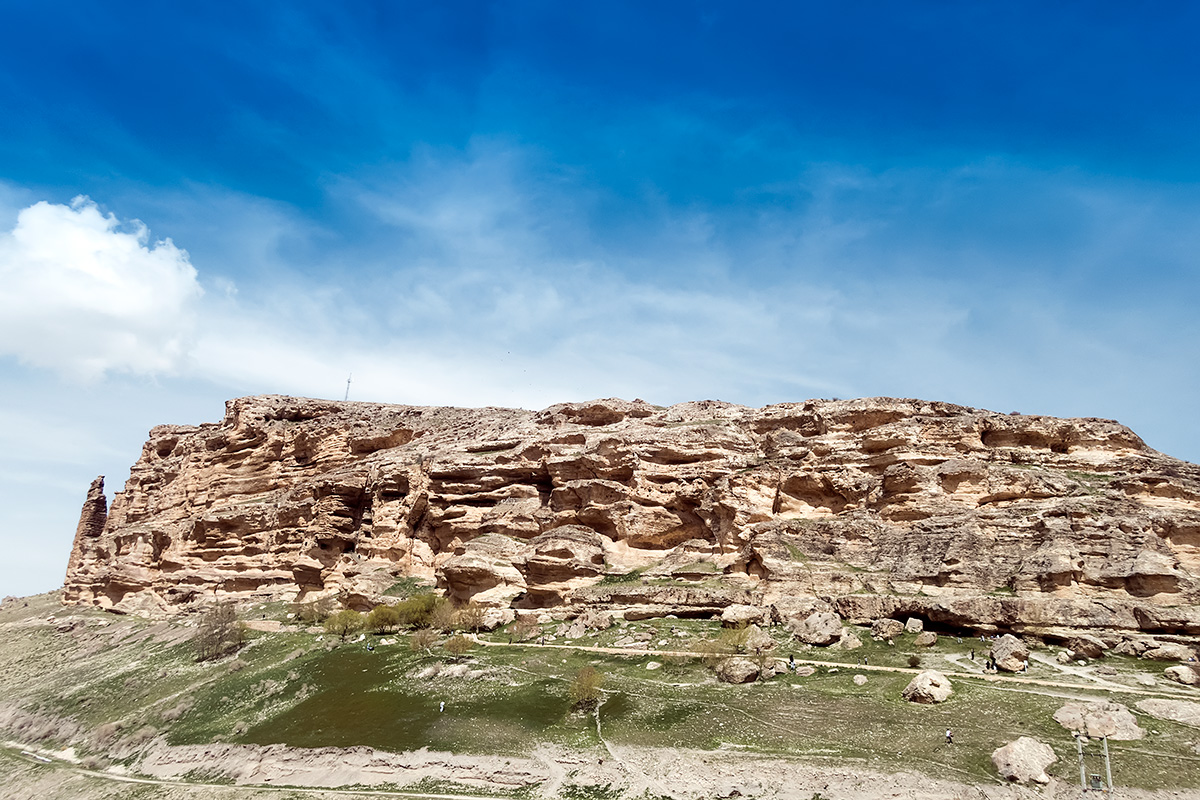

The Caves of Karaftu are a series of chambers that were carved into the cliff face of a mountain in the Kurdistan Province of Iran. The caves were formed naturally and were once supposedly under water, but after human settlement they were modified by inhabitants over the centuries. In ancient times, these caves were important from an economic point of view, as they were situated on the Silk Road, the ancient route from Syria and Iraq, leading through Iran to Afghanistan and China. Today, one of the most significant aspect of the caves is a Greek inscription found in them, an inscription that reads “Herakles resides here and no evil may enter”. The dating of the inscription suggests that the caves have been occupied since 4th century BC and the chamber where the inscription was found is still called the Temple of Herakles. The caves have been used continuously until present times and were known by locals as Karaftu Castle, and were often used in times of danger as a refuge.
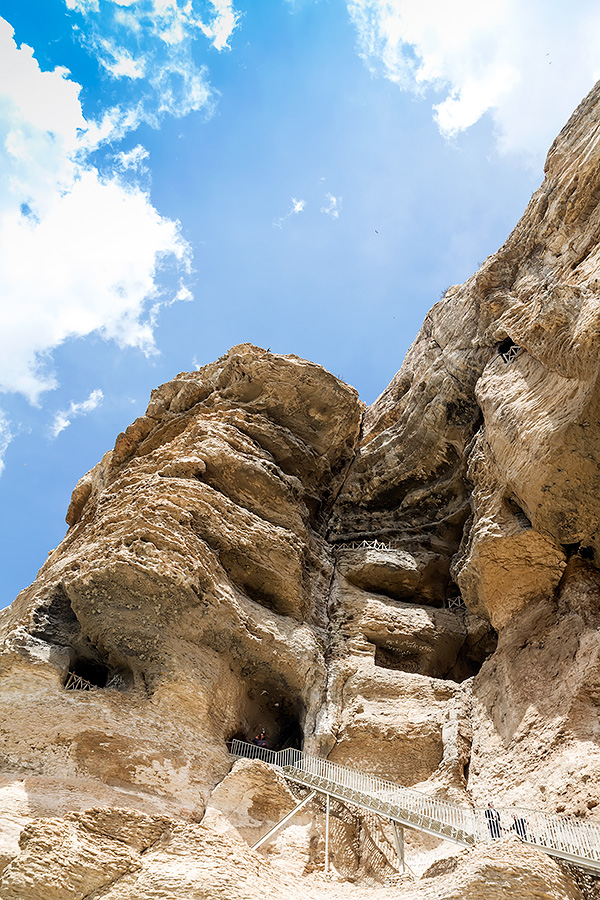

Karaftu Caves are only accessible via a common entrance on the southern side of the cliff that rises almost vertically, and the entrance to the caves is around 9 m off the ground. In times past, the caves could only be reached by using rope ladders, perhaps this was a part of defence mechanism put in place by Hercules before writing the sign on the wall. But today, fortunately for many tourists and locals alike, there is a long staircase leading up to the entrance. The architecture of the caves is remarkable. There are about 750 meters of interconnected corridors and chambers on four levels dug into the heart of the mountain. The height of the cave is about nearly 30 meters up from the entrance level. There is still water in certain parts of the cave. Some of the corridors are difficult to pass through, as the sizes of passages were intentionally constructed in a way to prevent successful attack. Water wells and ancient fireplaces can be seen along the chambers. Windows cut in stone give daylight.


We spent about two hours exploring the caves, then attacked, right there at the parking lot, a great watermelon. Extremely hospitable locals brought us some freshly made bread spiced up with leek and after they left we put some homemade dry pork sausages on it. Oh the infidels!
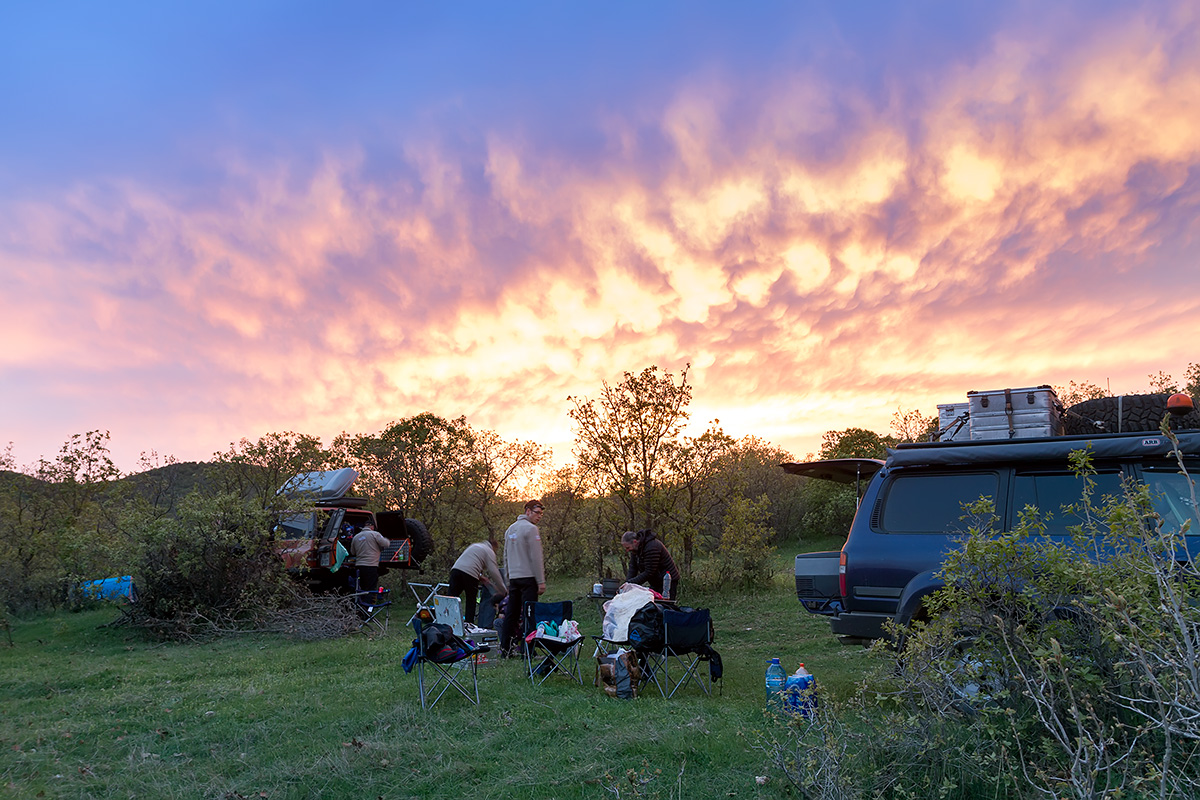
We spent the afternoon navigating and driving the roads through the valleys near Iraqi border towards Marivan. It became evident we’re in Kurdistan, mountains, ancient home of the Kurds, were all around us and were growing ever higher. And it was jom’e – all the suitable places and not so suitable places were occupied by Iranians having picnics. There were restaurants and shops along the way selling charcoal, so we bought 5 kilograms too. In the evening bivouac in the hills overlooking the Marivan Lake, also known as Zeribar Lake, we made fire and used the charcoal to light the shisha. We sat at the fire long into the night, drank tea I brought from Tunisia, and even the guitar found its players. It was Uroš Cvek’s birthday after all.


Useful information:
The entrance to the parking lot of Karaftu Caves is at the coordinates N36° 19.875′ E46° 52.632′. Parking is free but the entry fee for the caves is 100.000 IRR (1,62€) per person. Mind this is the double what Iranians pay. Take a flashlight if you want to explore the deeper tunnels. There is some natural and electrical lightning in the caves but your own light source can come handy. The paths through the caves are marked but it’s not that hard to get a little lost. There are some local restaurants offering tea and kebab at the place and the pipes with running water are placed among the terraces under the cliff. Not all of them function though.
Bear in mind that as you enter the mountainous landscape of Western Iran and approach Kurdistan, the local roads get narrower and bend much more. The vistas are amazing, but the travelling speed drops significantly compared to the Iranian highways.
Marivan may be a small town by Iranian standards but by European it is quite a big one. Good starting point for exploring Iranian Kurdistan and restocking the supplies from fresh vegetables to diesel. The Zeribar Lake may look promising for wild camping, but part of the shore is occupied by Marivan City Promenade (which was full of people when we arrived – jom’e, remember! – and the crowds occupied all the nearby woods too), the rest is mostly marshes covered in reeds. The hills above the lake, a few kilometres to the northeast, are a different story though. Your only challenge is to find a flat enough place along the pastures for your bivouac. Our place was at N35° 35.323′ E46° 08.780′.


Dodaj odgovor